Yusleep ReviewCan YuSleep Affect Your Driving the Next Morning? A Safety Guide
Can YuSleep Affect Your Driving the Next Morning? A Safety Guide
The short answer
YuSleep can cause drowsiness that may still be present the next morning, which can slow reaction time and reduce alertness. Do not drive or operate machinery until you know how it affects you, and never combine it with alcohol or other sedatives. If you feel groggy, foggy or unsteady, do not drive; choose another way to get where you need to go.
Some links on this site are affiliate links: if you buy through one, the site may earn a commission at no extra cost to you. More about this.
Here is what this guide covers:
- Why the morning after matters: how a sleep aid can linger into the hours when you are back behind the wheel
- Warning signs to check before you drive: the specific ways grogginess, slowed thinking and unsteadiness show up
- Mixing YuSleep with other substances: why alcohol and other sedatives raise the risk
- Timing your dose around your day: how bedtime and wake-up schedules affect what you feel in the morning
- Safer alternatives for getting around: what to do when you do not feel fully alert
If you have ever woken up unsure whether you are ready to drive, you are not overreacting. Many people take a sleep aid at night and assume that they will be clear-headed by the time they need to leave, only to find that heavy eyelids or a foggy head make the commute feel risky. That uncertainty is exactly what makes this question worth taking seriously.
Our aim here is to give you a clearer way to judge your own readiness, so you are not guessing. You will see which signs to watch for, why the effect can differ from one morning to the next, and how to plan your day so that driving does not depend on hope. This guide is based on published specifications and what buyers report, not on our own testing.
Why Sleep Aids Can Affect Driving the Next Morning
Taking a sleep aid at night is meant to help you fall asleep and stay asleep, but the effects don't always switch off when you wake up. Drowsiness can carry into the morning after some sleep aids, and how strongly it shows up varies from person to person. The same product can leave one person feeling clear and another feeling heavy for hours, so a good night on one occasion doesn't guarantee the next morning will be safe.
The main concern for driving is that impairment doesn't always feel like impairment. You can feel awake and still have slower reaction times, poorer focus and weaker judgement. Those are the skills you rely on when you brake for a child running into the road, merge into fast traffic or notice a hazard at the edge of your view. Published product information and buyer reports both describe morning drowsiness as a possible effect, which is why it deserves attention before you get behind the wheel.
Some practical points to keep in mind:
- Check the label and the vendor's guidance on how long after taking the product you should wait before driving.
- Pay attention to how you feel for the first hour after waking, not just whether you feel "fine" when you get up.
- Be cautious if you have a long or early drive, or need to operate machinery.
- Avoid combining the product with alcohol, and think carefully before adding anything else that causes drowsiness.
If you feel even slightly foggy, delay driving. Your brain's rhythm of waking up takes time to settle, and that is not worth rushing.
Signs You Are Too Impaired to Drive
Some people sleep, wake, and feel fine. Others wake up still carrying the effects of a sleep aid, and the only way to know which group you fall into is to check before you get behind the wheel. Use the checks below every morning after a night on any sleep product, and treat any "yes" as a reason not to drive.
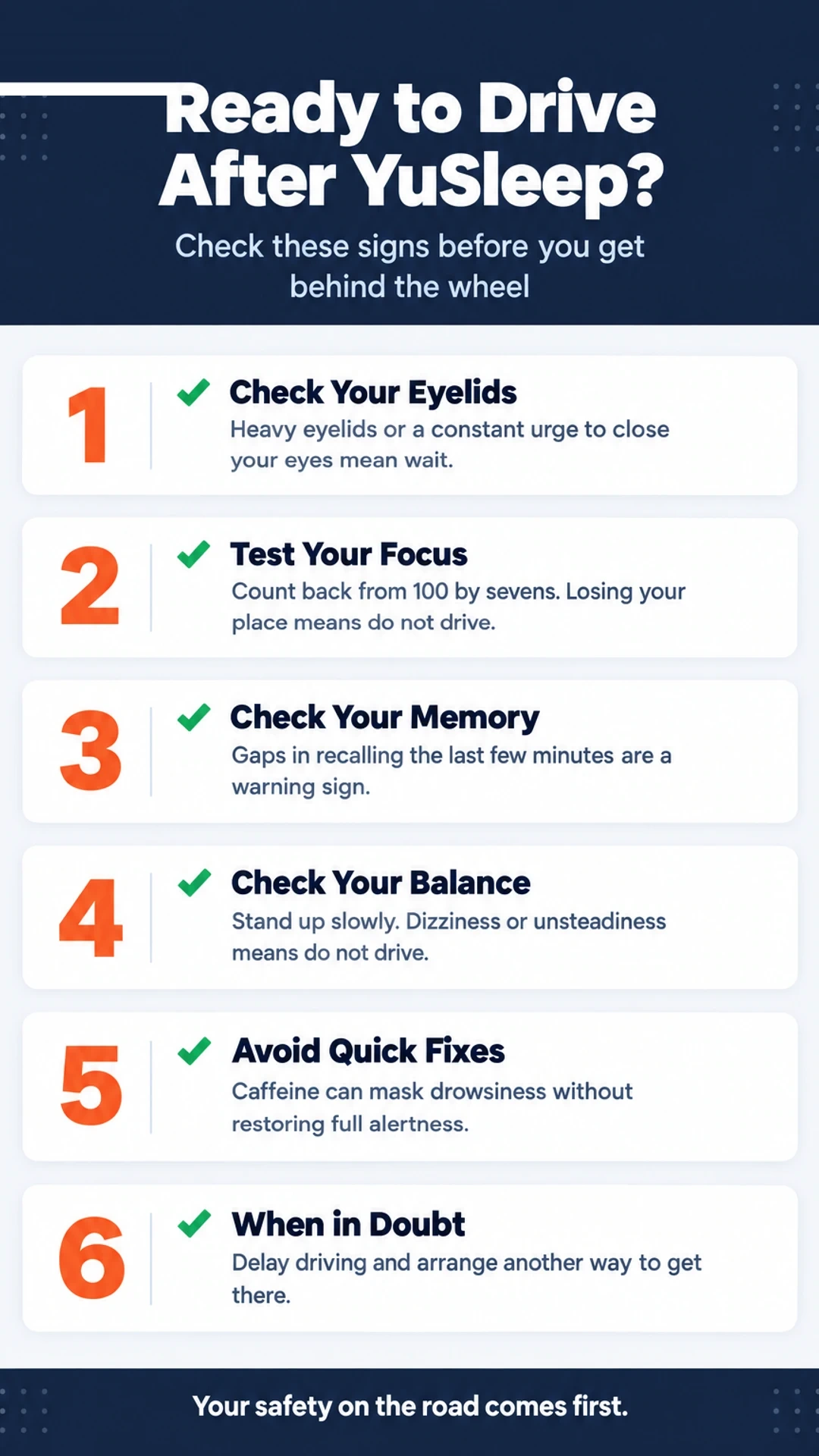
Are you groggy, heavy-eyed, or struggling to concentrate?
Ask yourself these questions when you first wake up:
- Do your eyelids feel heavy, or do you keep wanting to close your eyes?
- Does it take you more than a minute or two to feel mentally switched on?
- Do you have trouble following a simple thought, such as planning the route or reading a road sign?
Lingering drowsiness is one of the most common effects of sleep aids, and it can be slow to clear. If you are still feeling it, your brain is not ready to handle traffic.
Are your reactions slow or your attention drifting?
Do a quick mental test. Try counting backward from 100 by sevens, or name the steps of a familiar task. If you lose your place, make mistakes, or feel your focus slipping, that is a warning sign. Also ask whether you can clearly recall the last few minutes of your previous activity. Gaps in memory suggest that your attention is not working properly.
Do you feel unsteady or not fully clear-headed?
Stand up slowly and pay attention to how you feel. Dizziness, unsteadiness, or a foggy sense that you are not quite awake all count. Even if the feeling passes, the effects may still be affecting your reaction time, so do not drive on the assumption that they have gone.
If any of these checks raise doubts, wait, or arrange another way to get where you need to be. Avoid caffeine as a quick fix, since it can mask drowsiness without restoring full alertness. Your safety on the road matters more than an early start.
Driving Readiness Checks at a Glance
| Check | Ready to drive if | Do not drive if |
|---|---|---|
| Eyelids | Feel normal and light | Feel heavy or keep closing |
| Mental focus | Can count back by sevens | Lose your place or make mistakes |
| Memory | Recall the last few minutes | Notice gaps in memory |
| Balance | Steady when standing up | Dizzy, unsteady or foggy |
| Caffeine | Not used to mask drowsiness | Used to push through grogginess |
A Pre-Drive Checklist for the Morning After
Before you get behind the wheel after taking YuSleep, run through a short checklist. Driving is one of the most safety-critical things most people do each day, and drowsiness can impair it even when you feel fine. Taking a few minutes to check helps keep you and other road users safe.
1. Check the label and any instructions. Read the label and the included leaflet for any mention of driving, operating machinery, or next-day effects. Some products warn against activities that need full alertness for a set number of hours after use. If the label gives a timeframe, follow it. If it says nothing, do not assume that means it is safe to drive. Ask a pharmacist if you are unsure.
2. Consider when you took it and how you feel now. Look at the time you took your last dose and think about how long you have been awake since. The check that matters is how you feel right now, not how you felt when you went to bed. Ask yourself whether you feel clear-headed, whether your reactions are sharp, and whether you can concentrate on a task without drifting. Heavy drowsiness, a foggy head, or slow reactions mean you should not drive.
3. Account for other factors. Alcohol, other sleep aids, and even a short night's sleep can add to drowsiness. Coffee or caffeine can mask the feeling temporarily without restoring full alertness, so do not rely on it to make you safe to drive.
4. If in doubt, delay driving. When you are not sure, the safest choice is to wait. Give yourself more time, arrange another ride, or use public transport. If you need a firm answer, ask a pharmacist or your prescriber for guidance on your situation. Choosing not to drive is always the safer option when your judgment is uncertain.
Other Activities to Avoid After Taking YuSleep
Driving is the activity most people think of, but it is not the only one where drowsiness can cause harm. Operating heavy machinery, running power tools, climbing ladders and cycling in traffic all depend on quick reactions and steady judgement. If you are still groggy from a sleep aid, these tasks carry risks that are easy to underestimate.
Which tasks deserve extra caution?
Some activities are especially unforgiving if your attention drifts for even a second:
- Operating heavy machinery, such as forklifts, excavators or agricultural equipment
- Using power tools like circular saws, chainsaws or angle grinders
- Working on ladders or at height
- Cycling on roads or in busy traffic
- Any safety-sensitive job where a lapse could injure you or someone else
Each of these asks you to track your surroundings, react to sudden changes and judge distances accurately. Drowsiness slows all three.
Does the same rule apply to every task?
Yes. The practical rule is simple: if a task would be unsafe while drowsy, wait until you are fully alert before doing it. Many people find that "feeling fine" is not a reliable signal, because drowsiness can make you less aware of how impaired you actually are. If you are unsure, skip the task and do it later.
Be careful about combining YuSleep with alcohol or extra caffeine to push through a morning. Caffeine can mask sleepiness without restoring full alertness, and alcohol adds its own impairment on top. Neither is a safe shortcut before work that needs a clear head.
If you want to understand how the timing of your dose affects your mornings, see our guide on how to time YuSleep around your wake-up.
Who Needs Extra Caution
Not everyone who takes a sleep aid faces the same risk of carrying drowsiness into the next day. Some people should think harder about timing, and some should treat the question of driving or operating equipment as a real decision rather than a formality.
Am I one of the people who should be more careful?
You may be at higher risk if any of these apply:
- Shift workers, especially anyone who sleeps at unusual hours. A sleep aid taken during a day sleep can leave you feeling heavy when you need to be alert for the drive home.
- People with early commutes, where the gap between taking something at night and getting behind the wheel is short.
- Anyone with a long drive planned the following day, because drowsiness that feels mild at home can become dangerous on a motorway or a long rural road.
What happens if I mix YuSleep with other things?
Combining YuSleep with alcohol, other sedatives, or certain medicines can add to its sedating effect in ways that are hard to predict. Alcohol in particular can make the next morning's grogginess worse, and it is easy to underestimate. Check our interactions guide before combining it with anything else, and if you are unsure, ask a pharmacist.
I have felt groggy after sleep aids before
If a previous sleep aid left you foggy the next day, assume the same thing may happen again. Your past experience is one of the most useful pieces of information you have. Plan a morning without driving until you know how your body responds, and do not rely on feeling fine when you wake up, since drowsiness can be hard to judge from the inside. Caffeine can mask it for a while, but it does not restore your ability to react quickly.
What to Do If You Have Driven Groggy
If you have ever found yourself behind the wheel feeling foggy after a sleep aid, the most important thing is to act early. Drowsiness can come on gradually, and the moment you notice heavy eyelids, drifting attention, or missed exits, that is your signal to stop. Your brain is not fully alert, and reaction time suffers even when you feel "mostly fine."
Here is a practical sequence to follow:
- Stop driving as soon as you notice drowsiness. Do not push on to the next town.
- Pull over somewhere safe. Use a rest area, a well-lit car park, or a service station. Avoid the shoulder of a fast road.
- Rest, ideally with a nap. Even 15 to 20 minutes can help, though a short nap is not a full fix.
- Avoid relying on caffeine alone. Coffee may make you feel more awake, but it does not clear the sedation, and it can mask how impaired you still are. Never mix alcohol with any sleep aid.
Can I drive after taking a sleep aid?
Be cautious about long or late trips after taking a sleep aid. Plan alternatives in advance, such as a lift, public transport, or moving an early appointment, so you are not tempted to drive when you are not safe. Keep a plan B in your phone before you need it.
If the morning effect keeps happening, talk to your doctor or pharmacist about the timing or dose. Read the official label for the full safety information, since it sets out what the product is and is not suitable for.
Safer Options When You Feel Groggy
| Option | When to use it | Key point |
|---|---|---|
| Lift from someone else | Any morning you feel foggy | Plan it before you need it |
| Public transport | Long or unfamiliar routes | Not stated |
| Rest and nap | Drowsiness starts while driving | Pull over somewhere safe first |
| Move the appointment | Early or important trips | Not stated |
Frequently asked questions
How to stay awake driving early in the morning?
If you are driving early and feel drowsy, pull over somewhere safe and stop for a short nap or a 15 to 20 minute rest. Caffeine can help, but it takes time to work, so it should not replace stopping. Keep the cabin cool, open a window, and avoid driving at the hours when your body is normally asleep.
How long to rest after 2 hours driving?
A common guideline from road safety groups is to stop for a break of 15 to 20 minutes after about two hours of driving. Get out of the car, walk around, and drink some water. If you still feel sleepy after the break, stop for a longer rest or a nap before continuing.
Why do road trips make you sleepy?
Long, repetitive driving on flat, quiet roads gives the brain little to engage with, so attention drifts. Warm cabins, a full stomach, and a steady engine hum add to the effect. Drowsiness often builds slowly, so many drivers do not notice it until their focus has already dropped.
What are the risks of driving at night?
At night, visibility is lower, glare from headlights can be harder to judge, and drowsiness is more likely because most people's body clocks signal sleep in the late night and early morning hours. Fatigue slows reaction time and can cause drivers to drift out of their lane or miss hazards, and it can happen without any warning.
Can sleep aids affect how well you drive the next morning?
Some sleep aids can leave people groggy the next day, which can slow reactions and reduce alertness behind the wheel. The label is the best place to check for warnings about driving or operating machinery. If you are unsure how a product affects you, avoid driving until you know how you feel the next morning.
Wrapping up
Feeling drowsy behind the wheel is a real safety risk, whether it comes from a long drive or from anything that leaves you groggy the next morning. If you plan to drive soon after taking YuSleep or any sleep product, check the label for driving warnings and give yourself time to wake fully. When in doubt, delay the drive or ask someone else to take the wheel. Have you ever noticed morning grogginess affecting your driving? Share your experience in the comments.