Yusleep ReviewDoes YuSleep Make You Dream More? Vivid Dreams, Causes and What to Do
Does YuSleep Make You Dream More? Vivid Dreams, Causes and What to Do

The short answer
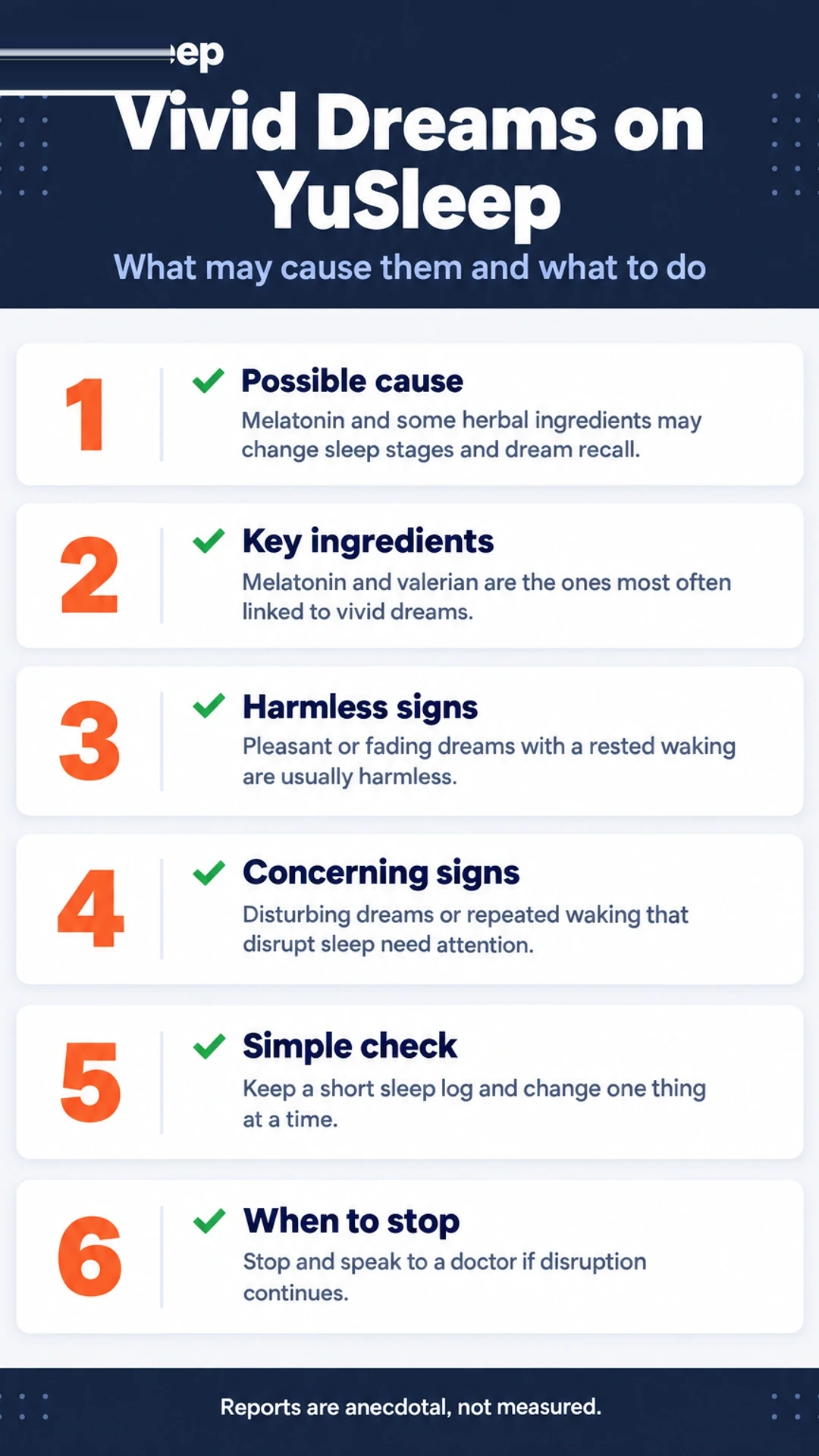
Some people taking YuSleep report more vivid or unusual dreams, especially in the first days or weeks. Melatonin and some herbal ingredients can change sleep stages and dream recall, so this is plausible. The product's own materials do not make dream claims, and reports are anecdotal rather than measured. If dreams are pleasant or fade, they are usually harmless. If they are disturbing or disrupt sleep, stop and speak to a doctor.
Some links on this site are affiliate links: if you buy through one, the site may earn a commission at no extra cost to you. More about this.
If you have started taking a sleep supplement and your nights have suddenly become busy, strange, or hard to shake off in the morning, you are not imagining it. Many people notice this shift and wonder whether the product is responsible, and whether they should keep going.
We want to give you a clearer picture than a simple yes or no. This guide is based on published specifications and what buyers report, not on our own testing.
Here is what we cover. We look at why sleep aids can change dream intensity and recall, which ingredients are most often linked to it, and how to tell a harmless change from one that needs attention. We also cover practical steps you can take, such as adjusting timing and keeping a simple dream log, so you can decide what fits your situation.
Where a question sits outside this page, we point you to the related guides in the YuSleep review hub.
What YuSleep Is and What Its Makers Claim About Sleep
YuSleep is a liquid drop supplement. The vendor positions it around three things: helping you fall asleep, helping you stay asleep, and supporting relaxation before bed. Those are the claims the product's own materials focus on, and they are the lens we use throughout this review.
The vendor's sleep-focused positioning means you should read its materials for what they actually cover:
- Falling asleep more easily at bedtime
- Staying asleep through the night
- Feeling calmer as part of a wind-down routine
What the materials do not do is make specific claims about dreams. There is no stated promise of more dreams, clearer dreams, or vivid dreams. So if you notice vivid dreaming after starting a sleep product, that is best understood as a reported side effect rather than a benefit the vendor advertised. Many sleep supplements in general are linked by buyers to dream changes, and the reasons are discussed in the sections that follow.
Can I find the full details somewhere else?
Yes. The YuSleep review hub page covers the full ingredient list, the liquid format, and what to check before you buy. We do not repeat that detail here, so it is worth reading that page alongside this one for the complete picture of the product.
Why Sleep Supplements Can Change How Vivid Dreams Feel
Most dreaming happens during REM sleep, the stage of sleep when brain activity looks much like it does while awake and the body is temporarily paralysed. A typical night cycles through REM several times, with the longest REM periods usually arriving toward morning. If the timing of your sleep shifts, or you wake up more often between stages, the balance of REM and other sleep can change, and that can change how much you dream and how much you remember.
Melatonin is a hormone your body makes to signal night to the sleep-wake cycle. Supplements containing melatonin are often taken to shift when you feel sleepy. Many people report that changing the timing or dose of melatonin alters their dream recall or how vivid their dreams feel, and that is a common observation rather than a settled finding for everyone.
A simple mechanism may explain part of the effect. Dreams are easiest to remember when you wake during or just after a REM period, because the memory of the dream is still fresh. If a sleep product makes you wake more often, or wake more lightly, you are more likely to catch dreams and recall them in detail, which can make them feel more vivid even if the dreaming itself has not changed much.
These are general mechanisms, not proof that YuSleep causes dream changes in a given person. Individual responses vary widely with bedtime, stress, caffeine, alcohol, and other medicines. If you notice unusual or disturbing dreams, the sensible first step is to check the timing and dose on the label, keep a simple sleep note for a few nights, and speak with a pharmacist or doctor if the changes continue.
Which Ingredients Are Linked to Dream Intensity
Many people who report vivid dreams on a sleep supplement are reacting to one or two specific ingredients, so it helps to know which ones come up most often. Melatonin is the usual suspect. It is a hormone that helps regulate the sleep-wake cycle, and some users say that taking it at bedtime leads to more memorable or unusual dreams. Herbal sleep ingredients are another common source of this talk. Valerian is the one most often mentioned, and some users describe its dreams as more intense or strange than usual.
It is important to be clear about the strength of this evidence. The link between these ingredients and vivid dreaming is reported anecdotally, mostly in user comments and forum discussions. It has not been consistently established in controlled research, and results vary from person to person. Some people notice no change at all.
Vitamins also turn up in these discussions, but evidence for a direct effect on dream vividness is limited. If a vitamin is part of a formula, it is worth treating any dream change as more likely linked to the melatonin or herbal content than to the vitamins.
If you want to know what each ingredient contains and how much of it is in a serving, the YuSleep ingredients page lists doses and the full composition. Use it as your reference rather than relying on memory or summaries, since amounts are what determine how strongly an ingredient acts.
Common dream-linked ingredients compared
| Ingredient | Typical role | Dream link reported |
|---|---|---|
| Melatonin | Regulates sleep-wake cycle | Anecdotal, varies by person |
| Valerian | Herbal sleep ingredient | Some users report intense dreams |
| Vitamins | Supporting nutrient | Limited direct evidence |
What Buyers Report, and How to Read It Fairly
Some buyers mention vivid or unusually memorable dreams after they start taking YuSleep. These reports tend to cluster in the first days or weeks of use, which is also when most people are still adjusting their routine. Vivid dreams are a minority of what reviewers describe, not a common pattern, so treat them as one possible experience rather than an expected one.
Reviews are a weak basis for judging how often something happens. A few reasons matter here:
- Selection bias: people who had a notable experience, good or bad, are more likely to write about it than people who noticed nothing.
- Unverified accounts: most reviews cannot be checked for dose, timing, other medicines or the reviewer's sleep history.
- Strong effects get posted more: a dream someone found striking is more likely to become a story than an ordinary night.
If you are weighing a review that mentions dreams, check whether it describes the timing, the dose and whether the dreams were pleasant or troubling. That detail tells you far more than a dramatic summary.
How do you tell a pleasant vivid dream from a disruptive one?
A vivid dream is not automatically a problem. Many people remember dreams more on some nights and feel fine about it. The useful question is whether the dreams affect your sleep and your day.
Signs a dream is simply interesting:
- You fall asleep without difficulty and wake up rested.
- The dreams are odd or detailed but not distressing.
- Nothing about them carries into your waking mood.
Signs a dream is disruptive:
- Dreams wake you repeatedly, or you lie awake afterward.
- They are frightening, upsetting or unpleasant enough to dread bedtime.
- Mornings feel worse, not just more memorable.
If the disruptive pattern continues, stop and speak with a doctor or pharmacist. Check the product page and label for the full ingredient list and the product's own cautions before you decide what to do next.
Vivid dreams: harmless or a concern
| Dream type | Signs | Suggested step |
|---|---|---|
| Pleasant vivid dreams | Rested waking, no distress | Keep monitoring |
| Disruptive dreams | Repeated waking, dread at bedtime | Speak to a doctor |
| Nightmares | Frightening, anxious on waking | Stop and seek advice |
| Daytime impairment | Unrefreshed, poor concentration | Stop and seek advice |
How to Tell If YuSleep Is the Cause: A Simple Check
If you suspect a sleep product is behind your vivid dreams, you can test the link yourself without any medical training. The method is simple: keep a record, change one thing at a time, and rule out the usual suspects first. This is a personal observation method, not a clinical test, so treat the results as a pattern to discuss with a doctor rather than a diagnosis.
Start with a two-week baseline. Before you begin taking YuSleep, spend about two weeks keeping a short journal. Each morning, note whether you remember dreaming, how vivid the dreams felt on a simple 1 to 5 scale, how well you slept, and what time you went to bed and woke up. Then keep recording the same details during use, adding the time you took your dose. A month of entries gives you something to compare against, which is far more reliable than trying to remember how you slept last week.
Change one thing at a time. Once you have data, adjust a single variable. You might move your dose earlier or later, or stop taking it for a few nights. If your dreams settle when you stop and return when you restart, that is a useful signal. Changing two things at once makes it impossible to know which one mattered.
Rule out other causes first. Many things make dreams more vivid, including:
- Stress or a demanding week
- Large or late meals
- Alcohol, especially close to bedtime
- Caffeine later in the day
- Irregular sleep times
- New medications
- Rebound effects after a poor night's sleep
Check these before you blame any product. Your journal will often show that a late dinner or a stressful stretch explains the change.
When Vivid Dreams Are a Concern and What to Do
Vivid dreaming is not automatically a problem. Plenty of people find that a sleep aid makes their dreams more memorable or more intense, and for many that is simply a curious side effect with no downside. The question is whether the dreams are enjoyable or neutral, or whether they are starting to hurt your sleep or your daytime life.
It helps to sort what you are noticing into a few rough categories:
- Harmless or enjoyable vivid dreams: colourful, unusual or detailed, but you wake feeling rested and the content does not bother you.
- Nightmares: frightening dreams that wake you or leave you anxious.
- Repeated distressing dreams: the same upsetting theme coming back night after night.
- Sleep fragmentation or daytime impairment: waking often, feeling unrefreshed, or struggling with concentration or mood during the day.
If your dreams are distressing, if they interfere with your sleep, or if you notice any daytime impairment, stop using the product and speak to a pharmacist or doctor. This matters more if you take other medicines, since a doctor or pharmacist can check for interactions. For the full list of reported effects, see our YuSleep side effects page.
Who should check with a clinician first?
People with mental health conditions, diagnosed sleep disorders, or who are pregnant should check with a clinician before starting any supplement, including this one. Our contraindications page covers who should avoid the product and which warning signs appear on the label. If you decide to stop, read our guide on stopping without rebound trouble sleeping before you do.
Frequently asked questions
Does valerian root make you have crazy dreams?
Some people report more vivid or unusual dreams after taking valerian, but this is anecdotal and not consistently shown in research. Vivid dreams are more often linked to sleep that is lighter, more broken, or shifting between sleep stages. Individual responses vary widely, so a change in dream intensity is worth noting and discussing with a pharmacist or doctor if it bothers you.
Does Yu sleep actually work?
Whether YuSleep works depends on what you expect it to do and on what its label and published information actually claim. Many buyers report feeling calmer or falling asleep more easily, while others notice little difference. Independent, product-specific clinical evidence is limited, so the most reliable way to judge is to compare the stated ingredients and amounts with what research supports for those ingredients.
What are the ingredients in Yu sleep?
The full ingredient list, with amounts per serving, is printed on the YuSleep label and product packaging, and that is the authoritative source. Check it against the sleep aids you already take, since overlapping ingredients can add up. If anything on the list is unfamiliar, look it up or ask a pharmacist before relying on the product.
Which vitamins are known to promote vivid dreams?
No vitamin is firmly established as a reliable cause of vivid dreams. Vitamin B6 is the one most often mentioned in anecdotal reports, usually at higher doses. Vivid dreaming is more commonly linked to sleep timing, stress, sleep disruption, and certain medicines than to any single nutrient, so vitamin intake is rarely the main explanation.
Can changing sleep supplements affect how vivid my dreams are?
Yes, a change in supplement or sleep aid can alter dream recall and intensity for some people, mainly because it changes how deeply and continuously you sleep. Dreams are often more memorable when waking happens during lighter sleep. Keeping a consistent bedtime and noting when dreams change can help you tell whether the product or other factors are involved.
Wrapping up
Vivid dreams with YuSleep are reported by some buyers, but the product's own dream claims are not independently verified. Check the label's ingredient amounts and compare them with the sleep aids you already take. Most dream changes trace back to sleep timing, stress, or disrupted sleep, not one nutrient. If dreams become distressing or persist, speak with a pharmacist or doctor. Have you noticed more vivid dreams after starting a sleep aid? Share what you observed in the comments.