Yusleep ReviewDoes YuSleep Contain Caffeine, Gluten, Dairy or Allergens? How to Check the Label
Does YuSleep Contain Caffeine, Gluten, Dairy or Allergens? How to Check the Label
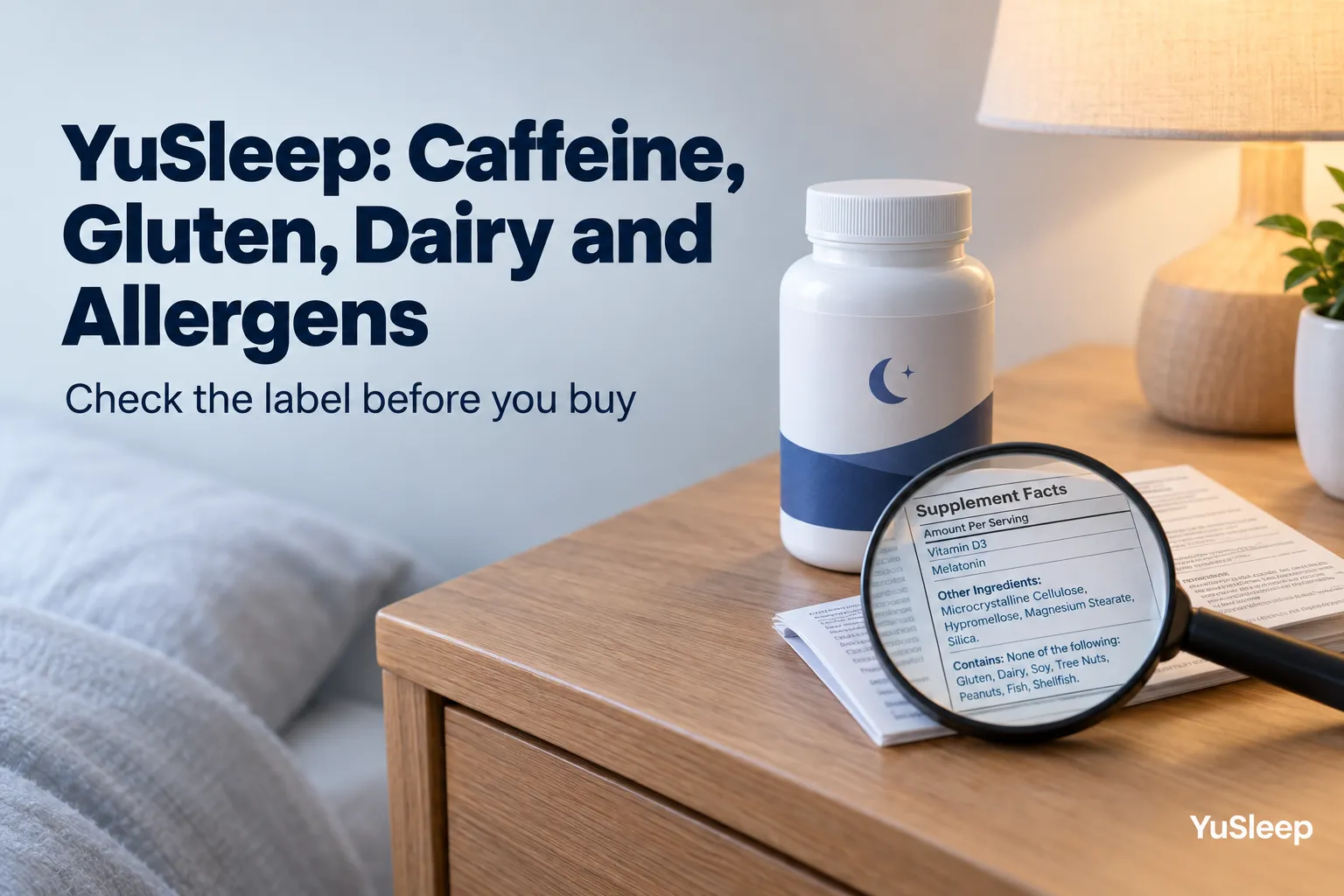
The short answer
Based on the ingredients published by the vendor, YuSleep is listed as containing no caffeine, dairy or gluten-containing grains in its main ingredient list. Formulations can change and facility cross-contact statements vary, so confirm the current label, look for 'contains' and 'may contain' lines, and contact the manufacturer if you have a serious allergy.
Some links on this site are affiliate links: if you buy through one, the site may earn a commission at no extra cost to you. More about this.
If you are scanning a supplement bottle at night with a sleep problem and a food restriction, you already know how frustrating it is to find one answer and then doubt it. You want a clear yes or no, and you want to be sure the label you are reading is the one that matches the product in your hand.
Here is what this page covers:
- Caffeine: what the published ingredient list shows, and why stimulant-free matters for a sleep product.
- Gluten: how to tell a gluten-free claim apart from a "may contain wheat" or shared-facility warning.
- Dairy: where milk-derived ingredients hide in capsules, fillers and coatings.
- Other allergens: soy, tree nuts, fish, eggs and sesame, and how to read the "contains" statement.
- Reading the label yourself: a short checklist you can use on any package, including this one.
This guide is based on published specifications and what buyers report, not our own testing. We compare the vendor's stated ingredients with how the labelling rules in your region are supposed to work, so you can check the details rather than take our word for them. You can find the wider context in our YuSleep review hub, which covers ingredients, format and price.
Quick Answer: Caffeine, Gluten, Dairy and Common Allergens in YuSleep
This guide is based on published specifications and what buyers report, not on our own testing. We have not verified the contents of any YuSleep package ourselves, so treat the answers below as a reading of the vendor's listed ingredients, and check the label on the bottle or box you actually receive.
Based on the ingredient list as published at the time of writing:
- Caffeine: The listed ingredients do not include caffeine or any caffeine-containing source.
- Gluten: No gluten-containing grain or ingredient is listed.
- Dairy: No milk, whey, casein or other dairy ingredient is listed.
- Common allergens: No major allergen (such as soy, egg, tree nuts, peanuts, fish or shellfish) appears in the listed ingredients.
These answers apply to the formulation described when this page was written. Vendors change recipes, and a new batch can differ from an older one, so the label always takes priority over this summary.
How do you check the label yourself?
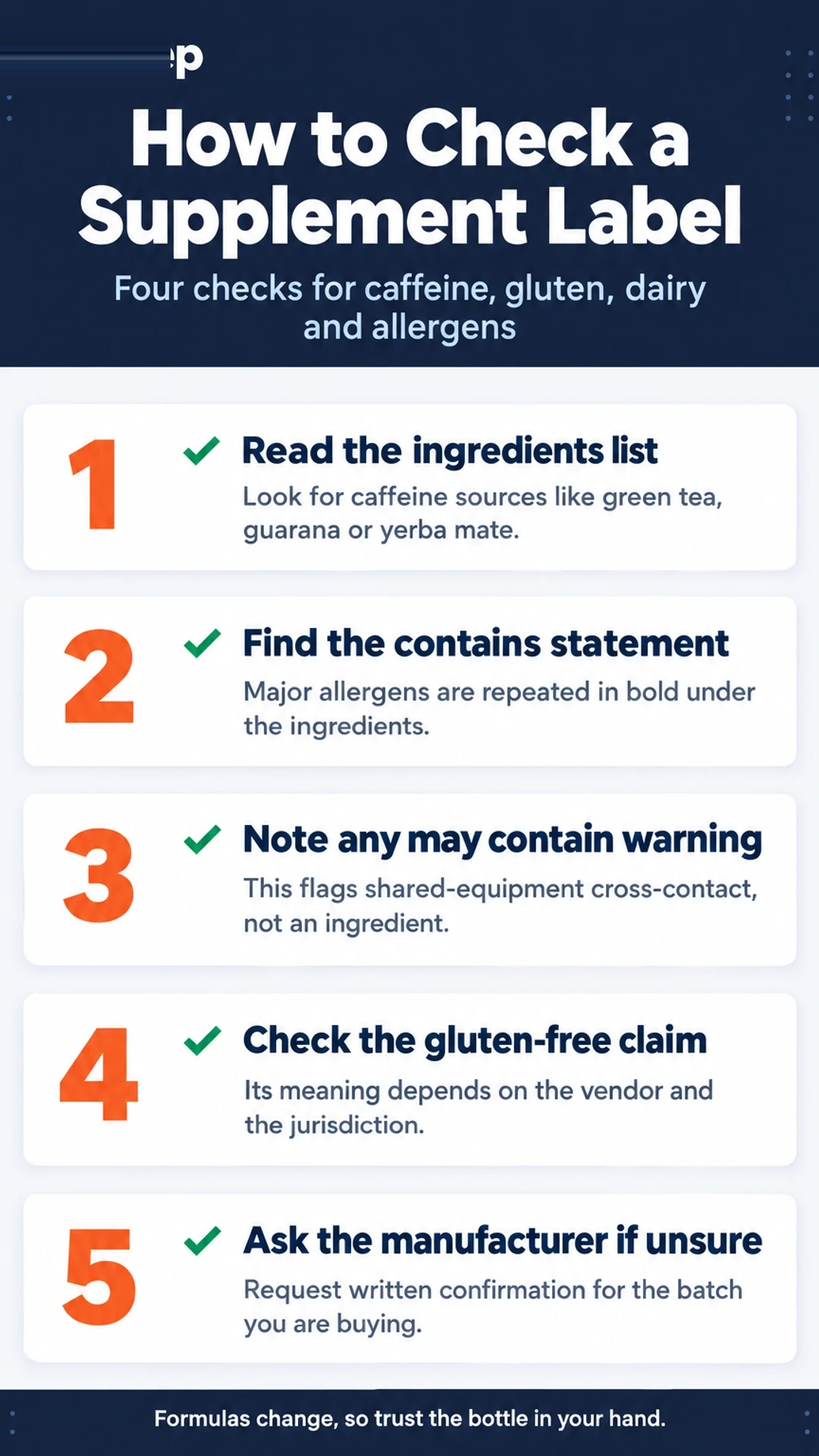
Look for three things. First, the full ingredient list, not just the front-of-pack claims like "natural" or "vegan." Second, any "may contain" or "made in a facility that also processes" statement, which signals cross-contact risk even when the ingredients are clean. Third, the "other ingredients" or excipients section, where fillers, flavorings and coatings often hide dairy or gluten derivatives. If a term is unclear, check the vendor's product page or the manufacturer's contact details before you rely on it.
Ingredient-by-Ingredient Allergen Check
We do not have YuSleep's full label or manufacturing documentation in front of us, so the points below are based on the ingredient names as they typically appear and on general knowledge of those ingredients. Check your own bottle against them before you buy, because formulations change.
Start with the ingredients that are usually free of the three restrictions people ask about most:
- Melatonin: a synthetic or plant-derived compound. It contains no caffeine, gluten or dairy. Confirm the form on the label, since some products add capsule shells that can differ.
- Red tart cherry: a fruit extract. It is generally free of caffeine, gluten and dairy, but flavoring or carrier ingredients in the same product can change that picture.
- L-theanine: an amino acid usually made by fermentation or extraction from tea. It is not caffeine, but it is tea-derived, so people avoiding caffeine on purpose should note its origin.
- GABA and 5-HTP: typically synthetic or fermentation-derived. Neither contains gluten or dairy by nature.
- Vitamin B6 and B vitamins: most are synthetic. Some B-complex blends are made with yeast or other fermentation media, which matters for some vegans and people avoiding yeast.
The harder questions are the source of gelatin, pectin and B vitamin carriers. Gelatin is animal-derived and pectin is plant-derived, so the label should say which one is present and, for gelatin, whether it is bovine, porcine or fish. If the label does not state the source, treat it as unknown and contact the seller for a written answer. The same applies to any "natural flavors" entry.
Caffeine: What to Check and Why It Matters for Sleep
Caffeine is one of the first things we look for when we review a bedtime product, and it is worth checking on the label before you buy. Check the full ingredients list on the product page or the packaging for a caffeine entry. If you see none, that is the starting point, but it is not the whole picture, because caffeine often arrives under other names:
- Green tea extract, which contains caffeine naturally
- Guarana, a seed that is a concentrated caffeine source
- Yerba mate, a tea-like herb with caffeine
- Energy-blend or "focus" additions that list botanicals without naming caffeine outright
Why does this matter for a sleep product? Caffeine is absorbed quickly and can stay in the body for several hours, so a dose taken in the evening can make it harder to fall asleep even if you do not feel wired. For a product meant to help you wind down, a caffeine-free label is a meaningful check, and anything that adds an energy blend works against its purpose.
Read the whole ingredient panel, not just the headline ingredient. Flavourings and "proprietary blends" can hide stimulant botanicals, so if a blend is listed without its contents, that is a reason to ask the manufacturer directly.
Where caffeine can hide on a label
| Source name | Caffeine content | Where it appears |
|---|---|---|
| Green tea extract | Naturally contains caffeine | Botanical extracts list |
| Guarana | Concentrated caffeine source | Seed or energy blends |
| Yerba mate | Tea-like herb with caffeine | Botanical extracts list |
| Energy or focus blends | Caffeine not named outright | Proprietary blend panels |
Gluten, Dairy and Cross-Contact: Reading the Label Correctly
When you check whether a supplement is safe for a gluten-free or dairy-free diet, the first thing to separate is the ingredient list from the rest of the packaging. An ingredient list tells you what is in the product. If wheat, barley, rye or milk-derived ingredients appear there, the product contains them, full stop. A "contains" statement, often printed in bold under the ingredients, repeats the major allergens so they are easy to spot.
A "may contain" or "made in a facility that also processes" warning is different. It describes cross-contact risk on shared equipment, not an ingredient. These statements are voluntary in many places, and their wording varies, so treat them as a signal to ask questions rather than as a measure of how much allergen might be present.
A "gluten-free" claim usually means something specific, but the detail depends on where the product is sold. Many regions set a numerical threshold for gluten, commonly 20 parts per million, and require the claim to meet it. Other markets set their own rules or allow looser language. Check which regulation a vendor is referring to if the claim matters to you.
- Ingredients list: what is in the product
- "Contains" statement: major allergens in the ingredients
- "May contain" or facility warning: shared-equipment risk, not an ingredient
- "Gluten-free" claim: meaning depends on the vendor and jurisdiction
If you have coeliac disease or a severe dairy allergy, do not rely on the label alone. Contact the manufacturer and ask for written confirmation of gluten and milk status for the specific batch you are buying. You can usually find contact details and product information on the official YuSleep website, and it is worth checking that the link you use is the official one before you send anything. Keep that written reply with your records.
Label signals and what each one means
| Label element | What it tells you | Action |
|---|---|---|
| Ingredients list | What is in the product | Check for wheat, barley, rye, milk |
| Contains statement | Major allergens in ingredients | Read in bold under ingredients |
| May contain warning | Shared-equipment cross-contact risk | Ask the manufacturer |
| Gluten-free claim | Meaning depends on jurisdiction | Check the regulation cited |
How to Verify the Current Formula and Contact the Manufacturer
Labels are the most reliable starting point, and the bottle in your hand is more authoritative than any web page, including this one. Find the lot number and the "best by" or expiry date, usually printed on the bottle base, the carton or the seal. Read the full ingredient list and any allergen statement on that specific package, because formulas change and older listings can be out of date.
If the label does not answer your question, contact the manufacturer through the support page or email address printed on the packaging, or on the official site at https://www.yusleep.com. Have your lot number ready. Ask specific questions and keep the replies:
- Does the product contain caffeine, and if so, how many milligrams per serving?
- Is the product made on equipment shared with gluten-containing or dairy-containing ingredients, and is it tested for gluten?
- What is the source of any dairy-derived ingredient?
- Has the formula changed since the lot number on my bottle was produced?
Treat the answers by strength of evidence. A written reply from the vendor and a certificate of analysis (CoA) for your lot are the strongest proof you can get. Marketing copy, including "gluten-free" or "dairy-free" wording on a product page, is the weakest, because it is rarely tied to a specific batch. If a vendor cannot give a clear answer, that is useful information too, and it is reasonable to choose a different product.
Who Should Be Most Careful and When to Ask a Professional
Some people need to be more careful than others before taking any supplement. If you have a food allergy, coeliac disease, a known sensitivity to caffeine, or you are pregnant or breastfeeding, check with a pharmacist or your clinician before you start. They can look at the full ingredient list alongside your own medical history, which is something a product page cannot do for you.
It helps to bring the label with you when you ask. Pharmacists are used to answering these questions and can tell you quickly whether a particular ingredient or excipient is a concern for your situation.
What signs mean you should stop and get help?
Stop taking the product and seek medical care straight away if you notice any of the following after taking it:
- Swelling of the face, lips, tongue or throat
- Difficulty breathing or wheezing
- Hives, a widespread rash or itching
- Dizziness or fainting
- A racing or irregular heartbeat
If symptoms are severe, call emergency services rather than waiting to see if they pass.
Where can you find more safety information?
Our page on who should avoid YuSleep covers the contraindications and warning signs printed on the label. For wider safety information, including what buyers commonly report, read our YuSleep side effects page. Neither replaces a conversation with a professional who knows your health history.
Frequently asked questions
Does YuSleep contain caffeine?
Caffeine is not a typical ingredient in sleep supplements, but you should not assume that. Check the 'Ingredients' list on the packaging or the manufacturer's product page. If caffeine, guarana, or green tea extract is not named, it is not listed as an ingredient. Note that the label is the authority here, not general expectations about the product category.
Is YuSleep gluten-free?
Gluten-free status is not something to infer from the ingredient names alone, since wheat or barley derivatives can appear in fillers, capsule shells, or flavorings. Look for an explicit 'gluten-free' statement from the manufacturer, or a certification mark. If neither appears, contact YuSleep directly and ask them to confirm in writing whether the product is gluten-free.
Does YuSleep contain dairy?
Dairy can show up as milk, whey, casein, lactose, or milk-derived fillers, and these are sometimes hidden under broader terms. Read the full ingredient list and any 'Contains' statement, which is required on many labels for major allergens. If milk derivatives are not named, the label does not indicate dairy. For a serious milk allergy, confirm with the manufacturer before use.
How do I check the YuSleep label for allergens?
Start with the ingredient list, then look for a 'Contains' or 'May contain' statement, which often lists the major allergens together. Check the packaging, the outer carton, and the product page, since they can differ. Pay attention to capsule and coating materials, not just the active ingredients. If anything is unclear, contact the manufacturer before taking it.
What should I do if I have a food allergy and want to use YuSleep?
Compare every ingredient against your specific allergen list, including inactive ingredients and sources of allergens. If a product's label is incomplete or you cannot verify a particular allergen, ask the manufacturer for their allergen statement in writing. Anyone with a severe allergy should consult a doctor or pharmacist before using a new supplement.
Wrapping up
Whether YuSleep contains caffeine, gluten, dairy, or other allergens comes down to the label, not assumptions. Read the full ingredient list, the 'Contains' statement, and any 'may contain' warnings on the package you actually bought. If something is missing or unclear, ask the manufacturer directly before you take it. What allergens have you found listed on your own YuSleep packaging?