Yusleep ReviewIs YuSleep Vegan or Vegetarian? How to Check the Ingredients and Capsules
Is YuSleep Vegan or Vegetarian? How to Check the Ingredients and Capsules
The short answer
YuSleep's vegan or vegetarian status depends on its current formulation, which can change. Check three things: whether the melatonin is synthetic, whether the capsule is gelatin or plant-based, and whether any other ingredient comes from animals. Most melatonin is synthetic, but the capsule and minor ingredients decide the answer. Confirm against the label you buy and the manufacturer's statement.
Some links on this site are affiliate links: if you buy through one, the site may earn a commission at no extra cost to you. More about this.
If you avoid animal products for ethical or dietary reasons, you have probably already hit the same wall: a supplement that looks simple turns out to have a capsule shell, a flavoring, or a coating you cannot identify. That uncertainty is frustrating when all you want is a bottle you can trust before bed.
This guide is based on published specifications and what buyers report, not our own testing.
You will learn how to read the ingredient list line by line, how to tell a gelatin capsule from a plant-based one, and which minor ingredients to question. We also explain why a "vegetarian" claim and a "vegan" claim are not the same thing. Along the way we point to related questions covered elsewhere in our YuSleep review, including the ingredient breakdown and melatonin content.
What Vegan and Vegetarian Mean for a Supplement
Before you can answer whether a product like YuSleep fits your diet, you need a clear working definition of each term. The two labels overlap less than many people assume, and the difference matters most in capsules, where ingredients you would never eat on purpose can show up in the shell, the coating or the carrier.
A vegan diet excludes all animal-derived ingredients. In a supplement, that means checking for things such as:
- Gelatin, usually from pig or cattle skin and bone, often used in soft capsules
- Beeswax, sometimes used as a coating or glazing agent
- Lanolin, a wool-derived fat
- Carmine, a red colouring made from insects
- Shellac, a resin secreted by lac insects, used as a coating
A vegetarian diet excludes meat and fish, but how strictly people apply it varies. Many vegetarians accept gelatin, dairy, eggs and honey, while others avoid some or all of them. So a product can be vegetarian for one person and unsuitable for another.
That is why the answer to "is YuSleep vegan" depends on your own definition. Decide which ingredients you exclude, then check the label and the manufacturer's published specifications for each one. Look at the capsule material as well as the active and inactive ingredients, since the shell is where animal derivatives most often hide.
Melatonin: Synthetic or Animal-Derived?
The question most people bring to a product like YuSleep is whether the melatonin itself comes from an animal. For most melatonin supplements sold today, the answer is no. The melatonin in most supplements is synthetic, made in a laboratory rather than extracted from animal tissue. That makes the active ingredient broadly compatible with a vegan or vegetarian diet, though the ingredients around it can still change the picture.
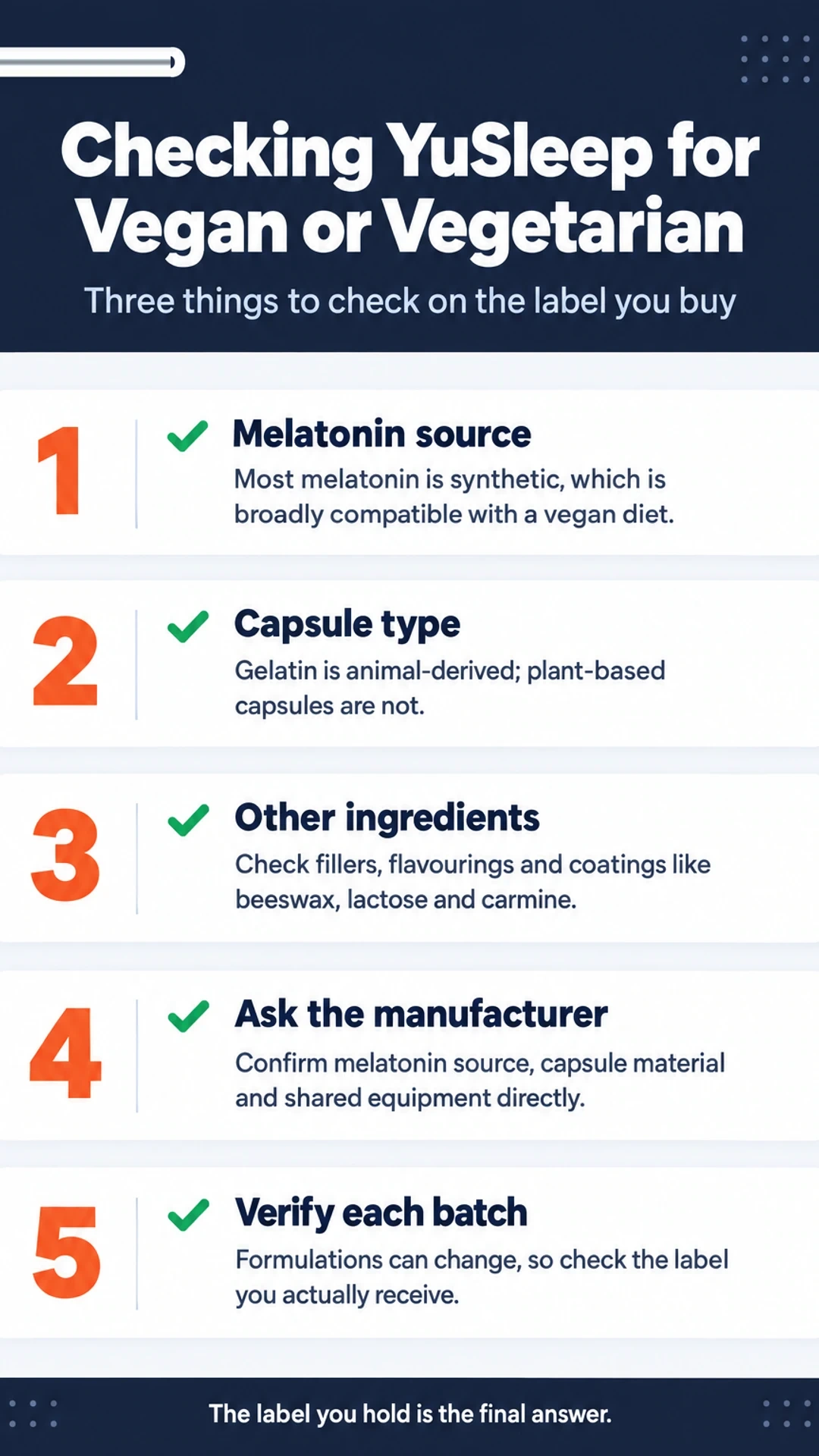
Because this is a researched guide rather than a product we have used, we cannot confirm the source of melatonin in any specific batch. The practical step is to check, in this order:
- Read the ingredient list and the supplement facts panel for any statement about the melatonin source or a "vegan" or "vegetarian" claim.
- Look at the capsule shell. Gelatin is animal-derived, while capsules made from plant cellulose or pullulan are not.
- Check the other fillers, flavorings and coatings, since these vary more between products than the active ingredient does.
- If the label does not state the source, contact the manufacturer and ask directly whether the melatonin is synthetic and whether the capsule is vegan.
Keep in mind that the active ingredient is often not the deciding factor. A product can use synthetic melatonin and still be non-vegan because of a gelatin capsule, a dairy-based filler or a shared-equipment policy the label does not mention. A vendor's own claim is worth noting, but it is still a claim until the label or manufacturer backs it up. For a closer look at what the formula contains, see our page on YuSleep ingredients and melatonin content.
Capsules and Carriers: Gelatin Versus Plant-Based
For most people asking whether a sleep supplement is vegan or vegetarian, the answer comes down to the capsule, not the active ingredients. The shell that holds the powder or oil is often where animal-derived material shows up, and it is easy to miss because it rarely appears in the ingredient list you read first.
What is gelatin?
Gelatin is usually made from animal collagen, most often extracted from pork or beef bone and skin. Because it comes from animals, a gelatin capsule is not vegan and is not suitable for vegetarians who avoid all animal products. Some people also avoid it for religious reasons, so it is worth checking even if you do not follow a particular diet.
What are plant-based capsules made from?
Most plant-based capsules are made from hydroxypropyl methylcellulose (HPMC) or cellulose, both derived from plants. These are the usual choice for products labeled vegan or vegetarian.
How to tell which one a product uses
- Read the capsule line on the label, not just the ingredient list. Look for words such as "gelatin", "vegetable capsule", "HPMC" or "cellulose".
- Check the manufacturer's product page or spec sheet, which often states the capsule material and any vegan or vegetarian certification.
- If the information is missing, contact the manufacturer directly and ask what the capsule is made from.
- Be aware that some products use a gelatin shell and the active ingredients are plant-derived. A plant-based formula is not automatically vegan if the capsule is not.
This guide is based on published specifications and buyer reports rather than our own testing. Confirm the capsule type on the label you actually receive, since formulations can change.
Common Capsule Types Compared
| Capsule type | Made from | Suitable for vegans |
|---|---|---|
| Gelatin | Animal collagen (pork or cattle) | No |
| Plant-based (HPMC or cellulose) | Plant material | Yes |
| Shell type not stated | Not stated | Not stated |
Plant-Based Versus Gelatin Shells
| Option | Pros | Cons |
|---|---|---|
| Gelatin capsule | Common and widely used | Not vegan or vegetarian-friendly |
| Plant-based capsule | Suitable for vegans | Not stated |
Other Ingredients to Check on the Label
Plant-based status often depends on less obvious ingredients than the main active. Capsules and supplements frequently contain animal-derived additives that are easy to overlook, so it helps to scan the full ingredient list rather than just the headline. Here is what to look for.
- Gelatin: a protein made from animal collagen, usually from pork or cattle bones and skin. It is common in soft capsule shells and some hard capsules.
- Beeswax: sometimes used as a coating or glazing agent on tablets and capsules.
- Lactose (milk sugar): a common filler in tablets and capsule powders. It is dairy-derived, so it matters for vegans and for people with dairy sensitivities.
- Carmine (also listed as cochineal or E120): a red colour made from crushed insects. It appears in some coloured capsules and shells.
- Shellac: a resin secreted by lac insects, used as a glaze.
- Lanolin-derived vitamin D3: vitamin D3 is often made from lanolin, which comes from sheep's wool. Look for "vegan D3" or "D2" if this matters to you.
Is fish oil ever plant-based?
No. Fish oil and other marine-derived omega-3 sources, such as krill oil, come from animals. If a product lists omega-3 without naming a source, ask whether it is algae-based, which is the usual plant-based alternative.
What do "natural flavour" and "may contain" mean?
"Natural flavour" can be derived from animal sources and is not always specified. "May contain" wording usually signals possible cross-contamination during manufacturing rather than a deliberate ingredient.
If the label is unclear, contact the manufacturer directly and ask whether any ingredient, flavour or capsule component is animal-derived, and whether the product is produced on shared equipment. Their answer is more reliable than guessing from the label alone. Our review of YuSleep's ingredients is covered in the hub page.
How to Confirm Vegan Status With the Manufacturer
A label that says "vegan" or "vegetarian" is a useful starting point, but it rarely answers every question. Some of the animal-derived details that matter to people who avoid animal products are not on the front of the pack at all. If you want a firm answer, you need to ask the manufacturer directly and check the reply against the packaging.
Start with these questions:
- Where does the melatonin come from? Melatonin is made either synthetically or extracted from natural sources. Ask which it is and whether any animal tissue is involved.
- What are the capsules made of? Many capsules use gelatin, which is animal-derived. Plant-based alternatives are usually made from cellulose or starch. Ask for the exact material, not just "capsule."
- Is there any flavouring or coating? Glazes, colourings and flavourings can carry animal-derived ingredients, such as shellac or certain carmine dyes. Ask for the full list of non-active ingredients.
- Is the product made on shared equipment? Some vegans avoid products made on lines that also handle animal-derived ingredients. Ask whether cross-contact is controlled.
A clear, written answer names each ingredient and states the source plainly. It does not rely on words like "natural" or "plant-derived" without explanation. Be cautious if the reply is vague, if the company avoids the capsule question, or if it cannot say what the shared equipment handles.
Vegan certification marks are worth checking, since they mean an independent body has reviewed the product. But a mark does not always cover shared equipment or every processing aid, so read the certifier's scope and still ask your questions.
Vegan, Vegetarian or Neither: A Decision Checklist
We cannot confirm from published specifications whether YuSleep is vegan or vegetarian, so the answer depends on checking the product yourself. The steps below will get you to a clear answer in a few minutes.
Work through the label in this order:
- Check the active ingredient. Find the sleep-support ingredient listed in the supplement facts. Synthetic or plant-derived sources are generally acceptable to vegans. Any ingredient named as coming from an animal needs a closer look.
- Check the capsule. Gelatin capsules are made from animal collagen. Look for words like "vegetable capsule," "plant-based capsule," or "HPMC" to see whether the shell is animal-free.
- Check the other ingredients. Scan for fillers, flavorings, colorings, and binders that may come from animals, such as gelatin, certain stearates, or some carmine colorings.
- Confirm with the manufacturer. If the label is unclear, contact YuSleep through the contact details on its official site. Ask for written confirmation of the source of each ingredient and the capsule type.
Once you have your answer, the result depends on your situation:
- Vegans need every ingredient and the capsule to be animal-free. A plant-based capsule and no animal-derived additives are required.
- Vegetarians avoid meat and fish but may accept some animal-derived ingredients, so a gelatin capsule may still be acceptable to you. Check your own standard.
- Anyone with no dietary rule can focus on whether the ingredients suit them and whether they have any allergies.
Questions about sugar-free and gluten-free status are covered on the hub page, YuSleep Review: Ingredients, Format, Price and What to Check Before You Buy.
Frequently asked questions
Are melatonin gummies vegan?
Many melatonin gummies are vegan, but not all of them. Gummies usually contain gelatin, which comes from animal collagen, unless the label says it uses pectin or another plant-based gelling agent. Check the ingredient list for gelatin, beeswax, or carmine coloring, and look for a vegan certification if you need certainty.
What are the ingredients in Yu Sleep?
The ingredients for YuSleep should be taken from the product label on the package you actually buy, since formulations can change. Look at the full ingredient list for the melatonin dose, the gelling agent, any sweeteners, colorings, and capsule shell, and note whether each one is plant-based, animal-derived, or unspecified.
Is natrol melatonin vegan friendly?
Natrol melatonin products vary by format. Some tablets and capsules are made without animal ingredients, while some gummies use gelatin. Read the specific label for the product you are considering, because vegan status depends on the exact formula and capsule or gelling material, not the brand name alone.
Are Olly melatonin gummies vegan?
Olly sells several melatonin gummy formulas, and their animal-ingredient status is not the same across all of them. Check the ingredient panel on your specific package for gelatin, and look for any statement about vegan or plant-based ingredients on the label or the manufacturer's own product page.
Wrapping up
Whether a supplement is vegan depends on the exact formula, not the brand name. The most common animal-derived items are gelatin in gummies and gelatin capsule shells. Read the full ingredient list on the package you are buying, and look for a vegan or plant-based label if you need certainty. If you have checked a YuSleep label and found something that surprised you, share what you saw in the comments.