Yusleep ReviewYuSleep Ingredients and Melatonin Content: What the Label Shows and What It Doesn't
YuSleep Ingredients and Melatonin Content: What the Label Shows and What It Doesn't
The short answer
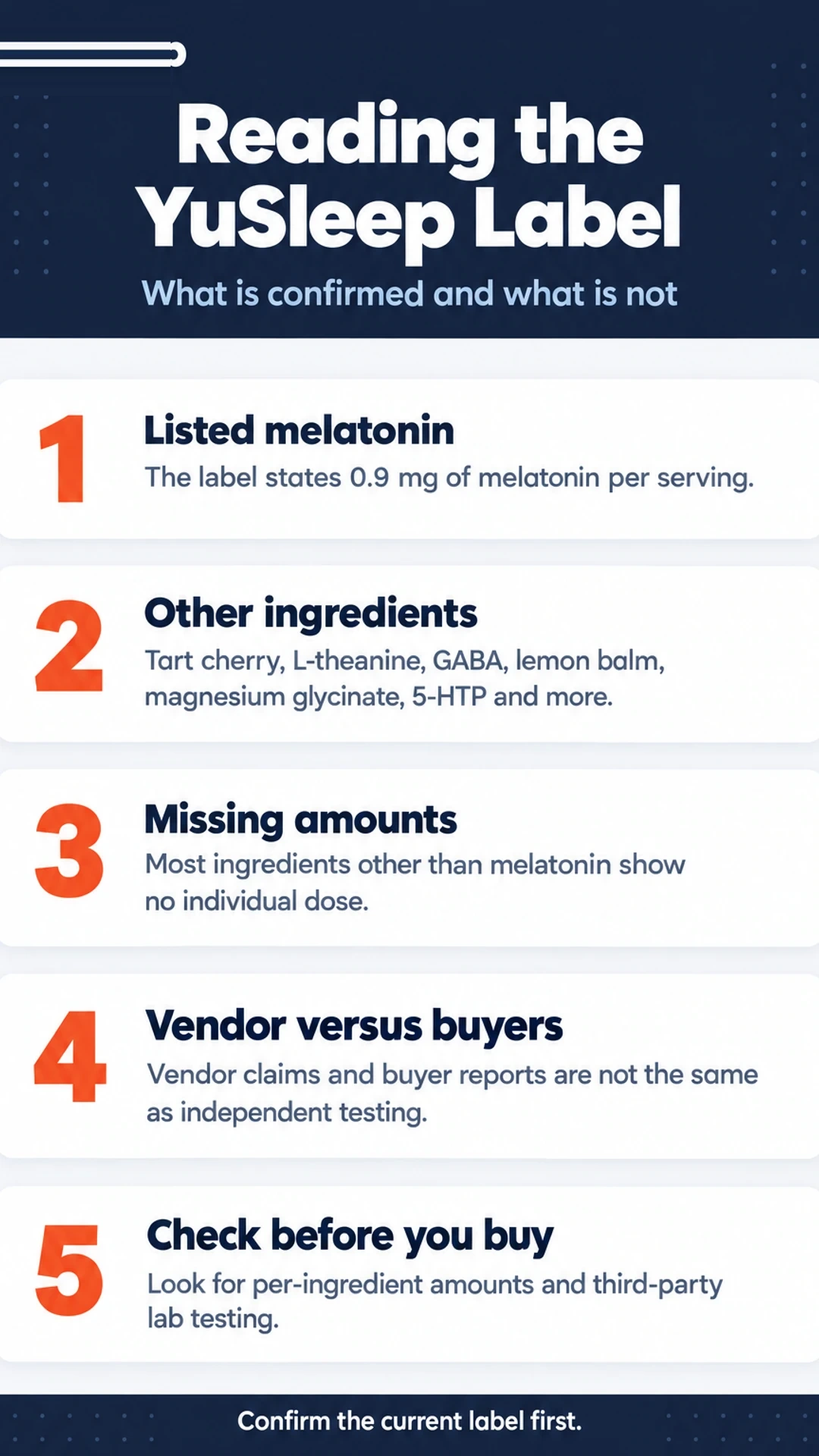
YuSleep is a liquid sleep supplement whose listed ingredients include melatonin, tart cherry extract, L-theanine, GABA, magnesium glycinate, lemon balm, and 5-HTP, among others. The label states 0.9 mg of melatonin per serving, according to a reviewer who checked the product. Many listed botanicals and amino acids do not show individual amounts, so the full dose of each ingredient cannot be confirmed from the label alone.
Some links on this site are affiliate links: if you buy through one, the site may earn a commission at no extra cost to you. More about this.
This guide is based on published specifications and what buyers report, not our own testing.
If you are trying to decide whether YuSleep is worth a try, the hard part is usually not the product name. It is working out what is actually in the bottle, how much of it you are getting, and whether that matches what you want before bed. Ingredient lists look thorough, but a long list tells you little until you know the amounts.
This page covers what we can and cannot confirm. Here is what it covers:
- Each listed ingredient: what it is and what it is generally used for
- The melatonin figure: what 0.9 mg per serving means and where that number comes from
- Missing amounts: which ingredients lack a stated dose on the label
- Vendor claims versus buyer reports: what the company says compared with what reviewers describe
- Questions to ask before buying: what to check on the label and vendor material
You can then compare the picture against the other pages in this hub, including the full product overview and dosing guidance.
What Ingredients Does YuSleep Contain?
The ingredient list is the first thing to check on any sleep supplement, and it is also the thing most likely to change. Formulas get reworked, amounts get adjusted and ingredients get swapped, so the list below describes what YuSleep's published material and buyer reports show at the time of writing. Before you buy, read the current label on the bottle or the official product page, and treat that as the authoritative formula.
As the label is organized, the ingredients fall into four groups:
Hormone-related
- Melatonin: the stated amount is 0.9 mg per serving, according to the vendor material and a published review.
Herbal and fruit extracts
- Tart cherry extract, which is often included as a natural source of melatonin-related compounds.
- Lemon balm, a traditional calming herb.
- Other botanicals listed on the current label.
Amino acids
- L-theanine, GABA and 5-HTP.
Minerals
- Magnesium glycinate, a form of magnesium commonly used in relaxation blends.
Grouping makes it easier to compare formulas. A product built mostly from amino acids and minerals works differently from one built around melatonin, so check which group carries most of the weight.
Note what the label does not always show. Several buyers have pointed out that the per-ingredient amounts for everything except melatonin are not listed, which makes it hard to judge dose. Keep that gap in mind when you weigh the formula against simpler options.
How Much Melatonin Is in Each Serving?
The label lists 0.9 mg of melatonin per serving. That figure is the starting point for understanding this product's sleep ingredients, and it is worth reading in context rather than on its own.
Luis Mihajlow, in his YouTube review of YuSleep, points out that the formula contains 0.9 mg of melatonin per serving, and he contrasts this with alternatives that rely on melatonin alone rather than combining it with other ingredients. That comparison describes the formula's design, not whether the dose suits you.
Melatonin doses in over-the-counter products vary widely, often from well under 1 mg to 10 mg or more. Lower doses are often discussed in connection with sleep timing, which is why some people find a small amount more useful than a large one. Whether 0.9 mg fits your own needs is a question to take up with a pharmacist or doctor, especially if you take other medicines.
A few things to keep in mind when reading the label:
- A stated dose is what the manufacturer says is in the bottle, not necessarily what is measured in it.
- Look for third-party testing from an independent lab, which checks whether the amount on the label matches the contents.
- Check the serving size, since the number only means something per serving.
- Note whether the label gives exact amounts for each ingredient or only a blend total.
Treat the 0.9 mg figure as a claim to verify, and use the label and vendor material as your guide.
Melatonin source and what the label states
| Source | Stated amount on label | Basis for the figure |
|---|---|---|
| YuSleep melatonin | 0.9 mg per serving | Vendor material and published review |
| Tart cherry extract | Not stated | Natural food source, amount not given |
| Other listed botanicals | Not stated | Not stated |
What Each Ingredient Is and What It Is Said to Do
Most of what you need to know about the formula sits on the label, but the label mostly tells you which ingredients are in it, not how much of each one is there or how strong the evidence behind them is. Here is what each main ingredient is, what its vendor says it does, and what general research suggests.
- Tart cherry extract. Tart cherries are a natural food source of melatonin. The amount per serving is usually small compared with a typical melatonin supplement, so it is not a reliable way to get a melatonin dose on its own. The vendor presents it as a natural sleep aid; the research on tart cherry for sleep is limited and mixed.
- L-theanine. An amino acid found in green tea. It is commonly described as relaxing, and some small studies report modest effects on calm and sleep quality. The evidence is preliminary.
- GABA. A neurotransmitter that is widely marketed for relaxation. Whether oral GABA reaches the brain in meaningful amounts is debated, so its effect on sleep is among the less well supported claims.
- Lemon balm. A herb in the mint family, traditionally used for nervousness and restlessness. Some small trials suggest mild calming effects. Results are inconsistent and the studies are small.
- Magnesium glycinate. A well-absorbed form of magnesium. Magnesium plays a role in nerve and muscle function, and some people use it at bedtime. Research on magnesium and sleep is mixed, and many adults do not get enough of it from diet alone.
- 5-HTP. A precursor the body converts into serotonin. It carries real interaction warnings, especially with antidepressants and other drugs that affect serotonin. If you take any prescription medicine, check with a pharmacist or doctor before using a product that contains it.
Keep in mind that a list of ingredients is not a list of proven effects. The vendor's claims describe what the formula is intended to do, and buyers' reports describe their experience, which varies from person to person.
What the Label Does Not Show
When you read a sleep supplement label, the list of ingredients looks reassuring. Each name appears, often with a short description, and it is easy to assume you know what you are getting. The gap is in the numbers. Two independent reviewers of YuSleep both point out that the exact amount of each ingredient is not disclosed. In Top Class Documentaries' review, the reviewer rated the product four and a half stars and named this as the main reason it did not get five. Shally-Entertainment's reviewer also reads the label as a list of ingredients without individual doses.
This matters because the dose of each ingredient is what lets you compare products and judge whether a formula is doing anything at all. A "proprietary blend" or a single total blend weight can hide how much of each ingredient is in a serving. You might see a total of several hundred milligrams without knowing whether one ingredient makes up most of it or only a trace.
Shopping the sleep supplement category is easier when you know what to check. On any label, look for:
- Per-ingredient amounts, listed in mg, g or a clear unit, not just a blend total
- A clear serving size, and how many servings each bottle contains
- Third-party testing, meaning a named independent lab, not a vague "tested for quality" claim
- An allergen statement that lists common allergens and any gluten or dairy content
If a label is missing these, that is not proof a product is poor, but it does mean you have less basis for judging it. Before you buy, check the official label and vendor material, and compare what you find with the claims made in the reviews.
Safety, Interactions, and Who Should Check With a Doctor
Before you start any sleep product, it helps to know what the ingredients can do alongside other medicines. Melatonin and 5-HTP can interact with several kinds of prescription drugs, including:
- Sedatives and sleep medicines, where the combined drowsiness can be stronger than expected
- Antidepressants, particularly those that affect serotonin, since 5-HTP is a serotonin precursor
- Blood thinners, which some sources note may be affected by melatonin
- Some other medicines, such as those that affect blood pressure or immune function
Because of this, a pharmacist can be a quick, useful check if you take anything regularly.
Who should talk to a clinician first?
Some people should get medical advice before using any sleep supplement. That includes pregnant or breastfeeding people, children, and anyone with a diagnosed sleep disorder. If you have a sleep problem that has been diagnosed, a supplement may not address its cause, so it is worth discussing the plan with your clinician rather than treating a supplement as a substitute.
What side effects should prompt you to stop?
Some grogginess the next morning is possible with any bedtime product, but it should not persist. Stop taking the product and seek medical advice if you notice persistent grogginess, headaches, or unusual mood changes such as new low mood, agitation, or anxiety. Keep the label and your dosing record handy, since that information helps a clinician work out what happened.
How to Check a Sleep Supplement Label Yourself
The fastest way to judge any sleep product is to read its label the way a pharmacist would, not the way the front of the box wants you to. This method works on YuSleep and on any other sleep supplement, so you can use it again the next time you compare options.
Start with the serving size, then work out the daily dose
Find the serving size and the number of servings per container, then check the amount of each ingredient per serving. Multiply that amount by the number of servings you will take each day. If the directions say two droppers, a serving of two droppers means you are getting double the per-serving amount. Write the daily total next to each ingredient so you can compare products on the same basis.
Look for proof of quality
Check whether the product carries a third-party testing mark from an independent lab. Then ask the vendor for a certificate of analysis (COA) for the batch you are buying. A useful COA shows the measured amount of each ingredient and confirms the product was tested for contaminants. A vendor that cannot or will not provide one is giving you less information to work with.
Compare the formula with your current medications and conditions
Before you order, list your current medications, supplements and any health conditions, then check them against the ingredient list. Some sleep ingredients interact with sedatives, blood thinners or antidepressants, and some are not suitable during pregnancy. If anything overlaps, or you are unsure, seek advice from a doctor or pharmacist before you start.
Frequently asked questions
Why is Beam Dream so expensive?
Beam Dream is priced above many basic sleep aids, and the price usually reflects the brand's formula, packaging and marketing rather than a single proven ingredient. A useful check is to compare the price per serving against the ingredient amounts on each label, since a higher price does not guarantee more of any active ingredient.
What is the strongest natural sleeping pill?
No natural sleep product is objectively the strongest, because products differ in dose, combination and individual response. Melatonin is among the most studied options for sleep timing, and its effect depends heavily on dose. Check the amount per serving on the label, and read the full ingredient list instead of relying on the word natural.
What is the ingredient in NyQuil that makes me sleep?
The sedating effect in NyQuil comes mainly from doxylamine succinate, an antihistamine that causes drowsiness. NyQuil also contains acetaminophen and dextromethorphan, which treat pain and cough, so its sleep effect is a side effect of a cold medicine. It is not designed as a sleep aid, so check the label before using it for sleep.
What is the safest sleep aid to use?
The safest choice depends on your health, medications and the cause of your sleep problem. Many people start with sleep habits such as a regular schedule and dimmed lights. If you use a supplement, choose one with a clear ingredient list and dose per serving, and ask a doctor or pharmacist before combining it with other medicines.
Does the YuSleep label show how much melatonin each serving contains?
The YuSleep label and vendor material state a melatonin amount per serving, reported as 0.9 mg in material a reviewer cited. The label does not show the exact amount of every other ingredient, so you cannot fully judge the formula from the label alone. Compare the stated melatonin amount with the dose you plan to take.
Wrapping up
The YuSleep label gives a melatonin amount per serving, but it does not disclose every ingredient's exact dose. Read the stated amounts against your own needs before buying.
If an ingredient matters to you, check whether its amount is listed and ask the vendor if it is not.
Which ingredient on a sleep label do you look at first? Share it in the comments.